Introduction
V. Simon, Ondrejov Observatory, and the MEDUZA Group have announced an
observing campaign for QR And. Ondrejov Observatory is a professional
astrophysical centre in the Czech Republic. MEDUZA is a group of observers
included in the B.R.N.O. (Brno Regional Network of Observers - the Variable
Star Section of the Czech Astronomical Society).
Why Observe QR And ?
QR And is a very interesting, and relatively bright variable star in the
north sky. It has been detected as a soft X-ray source quite recently,
and has been identified with a variable star (Beuermann et al. 1995, A&A,
294, L1). As QR And is not included in the observing programmes of any
other variable star societies, no long-term light curves exist.
Professional astronomers need more data to explain its behaviour, and for
this reason we have decided to invite all observers to join in a worldwide
campaign to monitor this interesting variable star.
Optical Variability of QR And
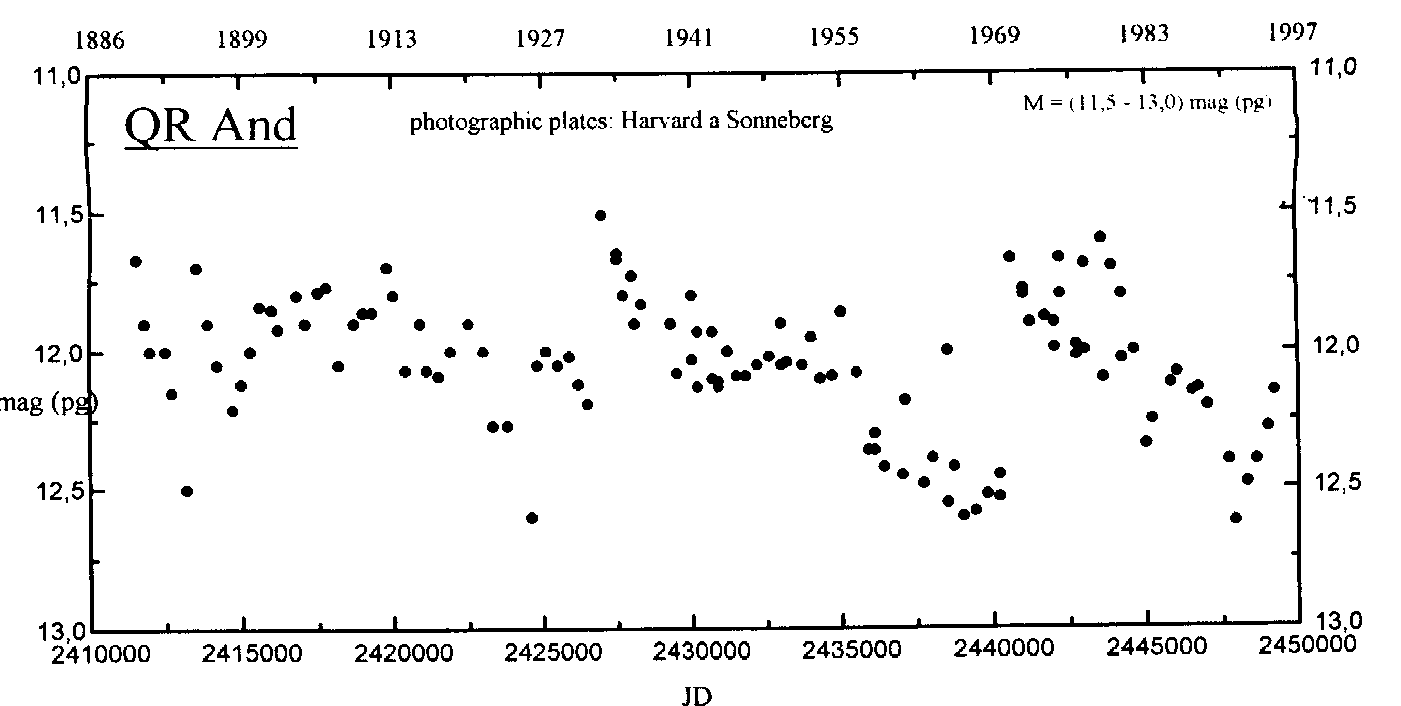
We chose some pieces of information from the only existing long-term light
curve, deduced from the Harvard and Sonneberg archival photographic plates
(Greiner and Wenzel, 1995, A&A 294, L5):
| Full size 1401x706x2 |
There are two large optical brightness jumps of about 1 magnitude. The rise time of the jump in 1969 is shorter than 10 months, whilst the jump in 1931/32 has a rise time of 14 months. Both of these intensity jumps are followed by a slow relaxation, which continues for approximately 20 years. Whether or not there was a similar jump at the end of the last century, which would imply a nearly periodic recurrence time scale of around 40 years, cannot be determined due to the sparse coverage, but certainly, at these times the object also showed the full amplitude of variability (>1 magnitude).
Many of the seasonal means are averages over irregular fluctuations. These variations occur on timescales of weeks to months, and the variability patterns are different from year to year. Thus, a considerable part of the scattering can be assigned to these irregular, short-term fluctuations with the resulting mean being dependent on the different coverage of bright and faint episodes.
Why is QR And so Unique?
QR And is a member of the group of the so-called supersoft X-ray sources.
According to the current model (van den Heuvel et al., 1992, A&A, 262,
97), these objects are close binaries, similar to 'classic' cataclysmic
variables (CV), except that the mass-donating star is of a higher mass.
Matter flows from the more massive star onto the less massive companion.
This phase is a brief episode in the evolution of a binary - the mass
transfer rate is extremely high at this time, much higher than in a classic
CV, and the mass-losing star tends to become less massive than its
companion. Due to the relatively short duration of this phase, there is a
very small chance of detection. QR And is one of the rare exceptions.
The high mass transfer rate makes the accretion disc much more luminous than in common CVs. Moreover, the large mass transfer ensures that steady-state hydrogen burning on the surface of the white dwarf is maintained. This thermonuclear reaction is a powerful source of extremely soft X-rays, a feature not imitated by any other kind of binary with an accreting compact object. A proportion of the X-ray radiation is absorbed by the accretion disc, which then increases in temperature, and the energy is re-radiated in the optical region. The luminosity of 'super-soft' binaries comes therefore not only from the accretion process, but also from the re-emitted radiation, and this results in the system being much brighter than a classic CV.
Unfortunately, although 'super-soft' binaries are a very powerful source of soft X-rays, they are rarely observed, because this wavelength range is so easily absorbed whilst travelling through the interstellar medium. Acquiring as much information about the variation of QR And in the optical region will make it easier to identify more distant members of this class of binaries, whose X-rays have been absorbed in the interstellar medium too much to be detected. The well known variable star V Sge may be a promising candidate (Steiner and Diaz, 1998, PASP, 110, 276).
How to Observe and Where to Send Observations
Because of variability on diverse timescales it would be advantageous to make
several visual estimates or CCD measurements during each night, but if this
is not possible, then single observations will also be of value. Please send
all visual observations to sobotka@physics.muni.cz and all CCD measurements
to simon@sunstel.asu.cas.cz. If you do not have access to e-mail, send your
observations to Petr Sobotka, Nicholas Copernicus Observatory, Kravi hora 2,
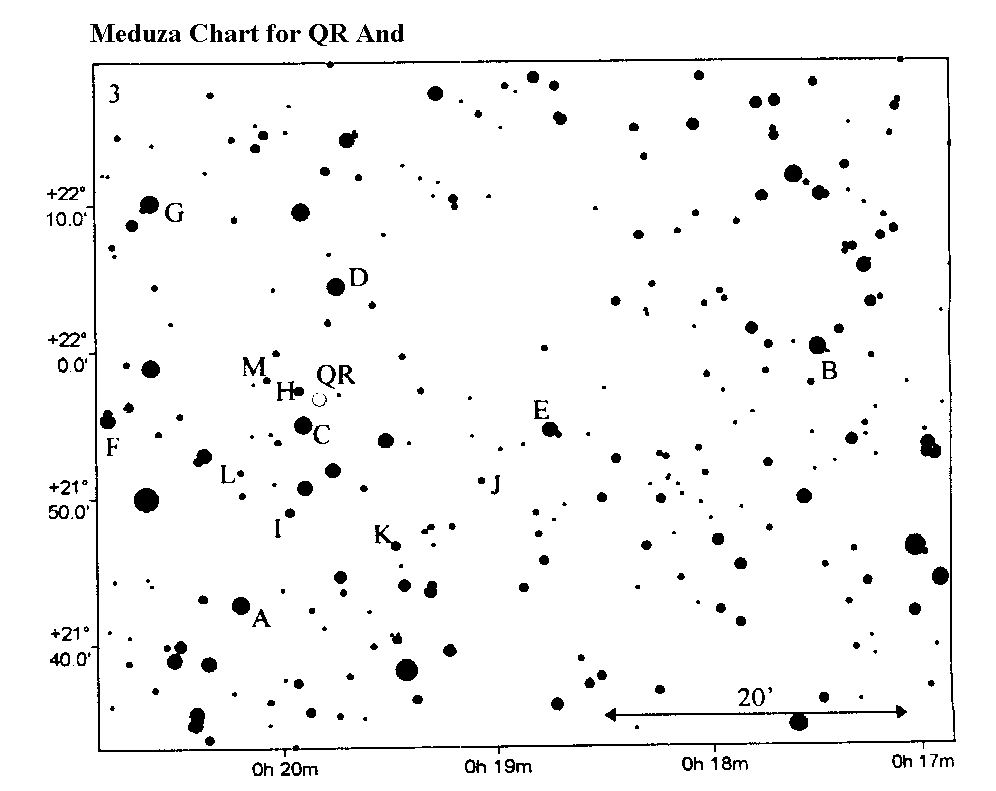
616 00 Brno, Czech Republic. A chart for QR And has been compiled, using
the Tycho Catalogue (Hipparcos) and GSC data (see below). QR And varies
between 11.5 - 13.0 mag(pg). Its amplitude in the visual region is not
known, therefore comparison stars cover the broad interval 9.98 - 13.9 mag
(V). Whilst the precision of GSC magnitudes is rather poor, all comparison
stars will be future targets for accurate photometry. Our database contains
not only reduced magnitudes and times of estimates, but the records of the
estimates as well. In this way we ensure that it is possible, at any time,
to re-process the content of the database, so taking account of better
measurements of the magnitudes of comparison stars.
Observation Form
Please, send all data in the following format:
| Position | 1 | 11 | 25 | 35 | 55 | 65 |
|---|---|---|---|---|---|---|
| Entry | Star name | Julian Date | Magnitude | Date (UT) | Observer's Code | Estimate or Estimates |
| Example | QR And | 2451139.256 | 11.28 | 1998-11-21.756 | PM | E4V2F, E4V9G |
The Julian date and date are rounded to three decimal places and magnitude is rounded to two places. The observer's code will be assigned to him (her) after the receipt of the first estimates. In the case of more than one estimate at the same time, please include all of them on the same line, separated by commas. For comparison stars, please use the characters given in the MEDUZA chart below. If the estimate is unsure, write a colon. Please include your full name, address and e-mail address. For CCD measurements, use comparison star 'C' (GSC 1185:1414, V= 10,55 mag, B-V= 1,46 mag) as a check star.
Meduza Chart for QR And (00h19m49s +21 56'52" 2000) |
|