British Astronomical Association Variable
Star Section
Latest News
December 27th 2011
The 80th name list of Variable Stars has been published in IBVS 6008. Check to see if any of your SDSS designations are included.
The following ROP stars have received new designations...
SDSS J072910.68+365838.3 = V654 Aur
SDSS J080434.20+510349.2 = EZ Lyn
SDSS J081321.90+452809.4 = FH Lyn
January 29th 2011
Catacysmic Variables - An introduction to the evolution, variability and science of natures most dynamic stars. Paper by Philip Hall uploaded to 'Articles' section.
September 15th 2010
The GCVS have appointed the following designation...
Nova Aql 2010 = V1723 Aql as announced on IAUC 9168
March 10th 2010
The GCVS have appointed the following official designations...
Nova Sco 2010 = V1310 Sco as announced on IAUC 9120
Nova Oph 2010#2 = V2674 Oph as announced on IAUC 9119
Please use these designations when reporting to the VSS.
January 28th 2010
Nova Oph 2010
The GCVS have appointed the official designation...
Nova Oph 2010 = V2673 Oph as announced on IAUC 9111
Please use this designation when reporting observations to the VSS.
December 29th 2009
New charts have been added for the following stars...
EG And, UU Aur, ST Cam, CH Cyg 9d and 1d, CI Cyg, AG Dra, RW Vir, RX Vir, V UMi.
Please replace your old charts with these new ones as soon as possible.
December 23rd 2009
The GCVS have appointed the following official designation...
Nova Aql 2009 = V1722 Aql
Please use this designation when reporting observations to the VSS.
December 3rd 2009
New designations for Nova Sct 2009 & Nova Eri 2009
The GCVS have appointed the following official designations...
Nova Sct 2009 = V496 Sct
Nova Eri 2009 = KT Eri
Please use these designations when reporting observations to the VSS.
zeta Aur
March 4th 2009
This bright long period ( 972 days ) EB has begun it's eclipse (March 4th) ,
and will be total for 37 days from March 5th. Mid
eclipse is scheduled for 22 March 2009. The system consists of a
relatively small blue star being eclipsed by a red supergiant. Totality lasts 37
days. As the eclipse in V is only about 0.3m ( about
3.70 to 4.00 ) it is not a good target for visual observers but is a good target
for DSLR photometry. On the other hand the eclipse in U
light is apparently two magnitudes. The comparison star is the familiar Lambda
Aurigae at 4.71V.
This system is interesting because ingress and egress lasts for 1.5 days. In
other words the small blue star, after it passes the outer
boundary of the supergiant, still shines through the supergiant’s atmosphere and
thus very gradual fades until totality. The light
curve during ingress and egress can provide useful information regarding the
nature of the supergiant’s atmosphere. The most detail
will emerge with those observations using a U filter.
Observations from now until March will be useful to establish any out of eclipse
variability. Observations of the eclipse are needed from
the beginning of March until the middle of April. CCD observations with a U
filter are particularly welcome. Please send all observations
to ( and enquiries ) :
Des Loughney, EB Secretary.
RASNZ Newsletter
March 3rd 2009
Dear Astronomer
The first 2009 issue of the Newsletter of Variable Stars South, RASNZ, is now
available for download (2 MB) from http://www.rasnz.org.nz/vss/Newsletters/VSS%20Newsletter%202009-1.pdf
This issue includes articles about VSS and its directions, about the first
research projects VSS is setting up (in which it hopes you will participate),
currently well-placed variables needing attention, using DSLRs for variable star
photometry, and some intriguing stars. There is also a notice about the
"Studying Southern Variables" Colloquium in Wellington in May, and a VSS
membership application form.
If you are receiving this as the contact person for an astronomical society,
kindly forward it to your Librarian, as we are very happy for you to print it
and deposit it in your library. Your newsletter editor might be interested too,
as we are happy for you to reproduce any material in it provided the appropriate
copyright notices are given (see last page).
Future numbers of the Newsletter, which is available for free to anybody, will
appear in the new website of VSS, www.varstars.org. The next issue is planned
for May. Please note this website is not yet operational. Until it is keep an
eye on http://www.rasnz.org.nz/vss/vss.htm. To keep abreast of variable star
news (a fast-moving part of astronomy) and the doings of VSS, join Austral
Variable Stars Observers Network at http://tech.groups.yahoo.com/group/AVSON/.
If you have any questions or comments about VSS and the Newsletter, please
contact me at the email address below.
Regards
Tom Richards
Director, Variable Stars South, RASNZ
tom.richards at varstars.org
February 27th 2009
epsilon Aur
' epsilon Aurigae Eclipse
Below is the predicted timetable for the eclipse. The dates are approximate
because it is suggested that the eclipse is due to a mass
of dust that occults the primary star every 27 years. By the very nature of such
a mass it’s size is uncertain. It is possible that the
eclipse may start before the predicted date or after. It is this uncertainty
that makes all visual observations valuable. In recent
months there have been periods of days/ weeks when observations across Europe
and North America have not been possible because of the
weather.
Between the start of the eclipse and totality the magnitude of
eps Aur should drop by about 0.7 magnitude.
CALENDAR OF ECLIPSE EVENTS:
2009 Aug 6th - predicted start of eclipse, rising with sun as a morning star
2009 Nov/Dec - eps Aur transits at midnight --> evening star
2009 Dec 21 - predicted start of totality, evening star
2010 May - eps Aur setting with the sun, mid eclipse brightening?
2010 Aug 1st - predicted time of mid-eclipse, early morning star
2010 autumn - end of mid-eclipse brightening?
2010 Nov/Dec - eps Aur transits at midnight --> evening star
2011 March 12 - predicted end of totality, evening star
2011 May 15 - predicted end of eclipse, next one starts in 2036.
RECENT ESTIMATES
Over the last few months there has been an intensive look at the eps Aurigae
system. One of the reasons for this study is to weigh up the
out of eclipse pulsations that occur in the primary star. These pulsations seem
to have an amplitude of about 0.1 magnitude.
For most of December 2008 and January 2009 eps Aur seems to have had a fairly
constant magnitude of around 2.99V. In February the system
started to slowly fade towards a pulsation minimum. At the time of writing (
24/2/09 ) the minimum seems to have been reached at about
3.09V.
It is expected that there will be a brightening to around 3.00 in April and then
a fade to a further minimum at the end of May.'
Des Loughney.
February 24th 2009
R CrB
Historical Light curve of the 1909 fade, and current light curve of 2008-09 fade can be seen here!
BAA Exhibition Meeting
The VSS will of course be represented at this yearly BAA meeting on June 27 at
the Old Royal Naval College, Greenwich, with displays of
Light Curves, section publications etc.
The official Exhibition Meeting Web Pages can be found at
http://www.britastro.org/exhibition
Observing Campaign - epsilon Auriga
July 1st 2008
The BAAVSS and SPA Variable Star Section will soon be announcing an observing campaign to monitor the long awaited eclipse in epsilon Aur. This observing campaign will also be held in conjunction with the AAVSO. Full details will be announced shortly (see http://www.aavso.org/vstar/vsots/eps_aur.shtml for information on epsilon Aur).
BAA/AAVSO Awards
April 12th 2008
At the climax of the joint BAA/AAVSO Cambridge meeting, two awards were made to members of the BAAVSS.
The first award of honorary AAVSO membership was presented to the VSS Director Roger Pickard by AAVSO Director Dr. Arne Henden. Dr. Henden writes...
In recognition of his contributions to and support of international
cooperation in the creation and dissemination of standardized
comparison star sequences and charts, encouraging and promoting the exchange of
information, data, and ideas between the British
Astronomical Association, Variable Star Section, and the AAVSO, his lifelong
contributions to variable star research as an observer, and
his distinguished service as Director of the BAAVSS, this is to certify that
Roger D. Pickard
is an Honorary member of the American Association of Variable Star Observers
for life, and is thereby entitled to all the privileges pertaining thereto.
The second award was made to Gary Poyner, who received the Charles Butterworth award from the VSS Director Roger Pickard. Roger writes...
Members will be pleased to know, I'm sure, that Gary Poyner was presented
with the Charles Butterworth Award at the joint meeting of the BAA and AAVSO
last weekend. This is given to individuals who have made an outstanding
contribution to variable star astronomy.
The citation reads:
"This, the second Charles Butterworth award, was presented to Gary Poyner on
12th April 2008 by the Variable Star Section of the British Astronomical
Association in recognition of him becoming the first European to accrue 200,000
visual observations of variable stars."
The award took the form of a slate bed inscribed with the light curve of DY Per
(taken from Gary's web page!) and with the above wording around the
edges.
The only observers to have accomplished this amazing feat include Albert Jones
with over 500,000 and still observing; Danie Overbeek with around
285,000 and Wayne Lowder who made some 209,000 observations. From the UK only
two other observers have done 100,000 (half Gary's total) John Toone
with 128,000 and still counting and, of course, Charles Butterworth who made
some 106,000 and was the first to achieve this goal. It should be noted
that Gary has now also surpassed Wayne Lowder's remarkable total.
I should also perhaps remind members that Arne Henden was the first recipient of
the Butterworth Award.
BAAVSS & SPA VSS Joint Observing Programme.
March 3rd 2008
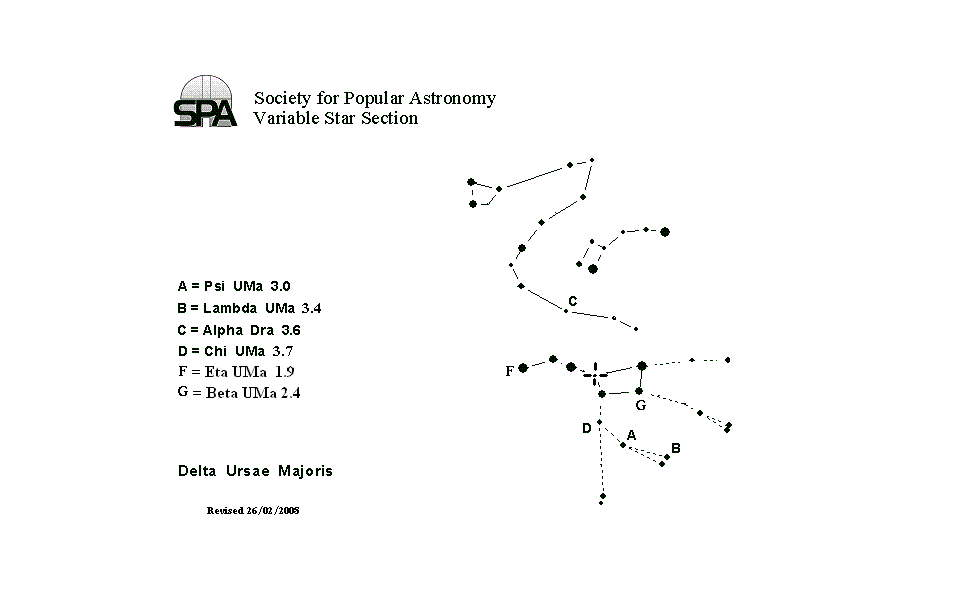
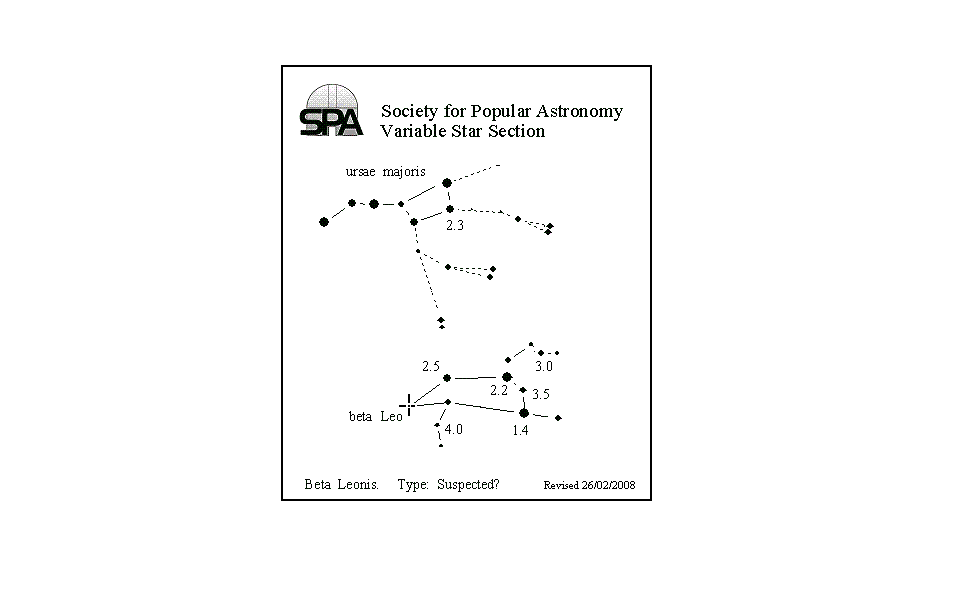
The Society for Popular Astronomy (SPA) and the BAA VSS have agreed to launch a
joint observing programme, namely to observe delta UMa and beta Leo as suspected
variables.
The SPA already have visual observers conducting naked eye observations but we
feel it will be advantageous if VSS observers also contribute. In addition, it
will be useful for observers who
have the capability to undertake photometry to submit observations.
It'll be interesting to see what, if any, variations we see with what amplitude
and with what periodicity.
Richard Miles and Des Loughney have already performed photometry on both stars
but it is too early yet to draw any conclusions.
Charts for delta UMa and beta Leo can be downloaded here:
Roger Pickard, BAA VSS
Dave Scanlan, SPA VSS
OJ287 Final Update - July 1st 2008
The observing campaign has now ended, with the results published in the following papers...
The Structure of the October/November 2005 outburst in OJ287 and the precessing Black Hole model. M. Valtonen, M. Kidger, H. Lehto and G. Poyner. A&A, 477 2 (2008) 407-412.
A massive binary black hole system in OJ 287 and a test of general relativity. Valtonen et al, NATURE (letters) Vol 452 April 17 2008.
The web page displaying the complete set of light curves compiled throughout the campaign will remain.
Gary Poyner
http://www.garypoyner.pwp.blueyonder.co.uk/oj_camp.html
Section Meeting
- Saturday 3rd June 2006 - Brief Report