Last updated 2014April 16
NEWS ARCHIVE
(Please be
aware that some of the links on this page may no longer be active. Inactive
ones so identified have been removed.
2013 October 31: Observing Campaign: November Appulse of three Minor Planets
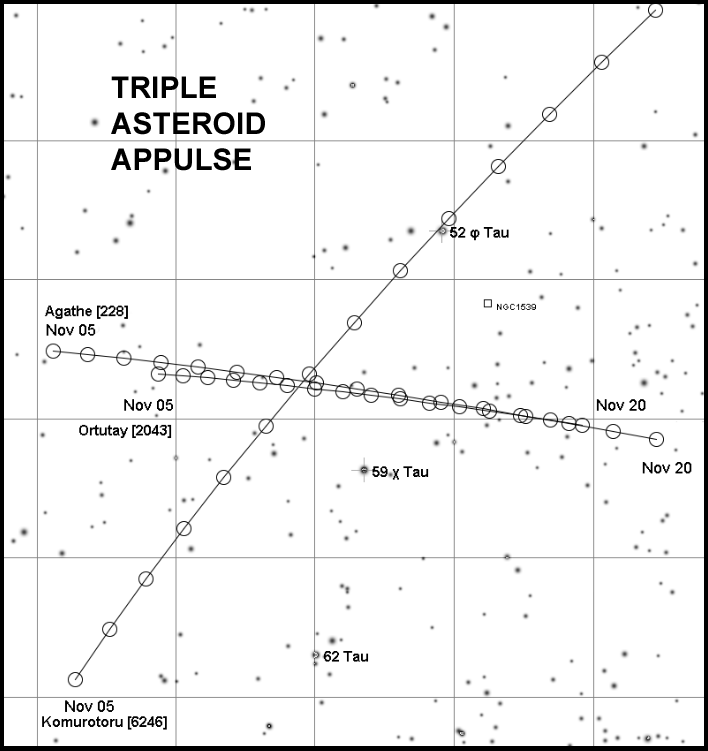
During November 9-12, three asteroids (228 Agathe, 2043 Ortutay and 6426 Komurotoru) happen to pass close to one another as seen in the constellation of Taurus. In reality these objects are very well spaced apart: they just happen to lie close together when seen along our line of sight. You therefore have an opportunity to simultaneously observe all three bodies in the same CCD field of view. The best nights are Nov 10/11 and Nov 11/12 when they will all be contained within a patch of sky some 22' across. The earlier night will be best of all as the Moon will be further away and a little fainter then. The apparition will be favourable as the field will be relatively high in the sky throughout most of the night - visible from 2000UT-0600UT as seen from the UK.
The Plan: We already know the rotation period of 228 Agathe (6.5 hours) but do not know the periods for the other two objects. If several observers take time-series of these minor planets, we may have enough data to solve the two unknown rotation rates. Another, more novel approach would be to try and detect any significant colour changes (by measuring the colour of each expressed relative to the others) during the course of a night. The minimum requirement would be to take alternative series of images (say 10 at a time) through two different filters (e.g. using V and R filters) for several hours. Very few asteroids are known to exhibit colour variation as they rotate. It would be good to discover some new ones!
Graham Relf has posted a full chart depicting the appulse here on the Computing Section webpages. All three asteroids are 14th magnitude so you'll need a fairly large scope to participate effectively. For more details, or if you are planning to attempt observations then do contact the Director. Here's a plot of their motion between November 5-20 - the grid shown is about 1 degree square:

Good luck!
2013 October 02: Video Astrometry - A new observing opportunity
Section member Alex Pratt is a keen occultation observer for which he uses an integrating Mintron video camera and GPS time-inserter to record asteroidal and lunar occultations of stars. Recently he used his observing equipment to record the passage of some fast-moving asteroids, notably 1998 QE2 and 2012 DA14. Exposure times as short as 0.04 sec per frame can be employed yet, using relatively wide-field optics, several field stars were recorded in addition to the asteroids and so it was possible to measure the astrometric positions of the movers with high precision thanks to the very accurate time stamp on each frame. What made all the difference was the availability of the software TANGRA 1.4 written by Hristo Pavlov with which it is possible to analyse the frames for both astrometry and photometry.
Thankfully, Alex has compiled A Guide to Video Astrometry for anyone wishing to try using a video camera for measuring the positions of very fast-moving objects (VFMOs). This 2.2 Mb PDF is a nice step-by-step 'How-To' guide which sets out all aspects of the process involved and includes relevant weblinks. His results proved good to an accuracy of about 0.2 arcseconds even for an object moving at a rate of some 10 arcsec per second of time! He even used the equipment to measure the positions of some main-belt asteroids, which after submitting these to the Minor Planet Center enabled him to receive his own IAU Observatory Code (Z92). Great work, Alex!
2013 Feb 15: Record close approach of 2012 DA14
Unlike the bolide seen and felt in the Urals earlier the same day, the dramatic passage of near-Earth asteroid 2012 DA14 has been forecast one year in advance thanks to it having been discovered last February by amateur astronomers at the La Sagra Sky Survey in Spain (MPC Code J75). Today 2012 DA14 will approach to within about 27,600 km of the Earth's surface at about 19:24 UT whilst travelling at 7.8 km/sec. During the last week many more observatories have imaged the object, in particular; Mount John Observatory, New Zealand (MPC Code 474); the 2.0-m Faulkes Telescope South (which is now back in business after last month's devastating bushfires which badly affected Siding Spring and the surrounding community) (MPC Code E10); as well as the new LCOGT 1.0-m 'B' telescope at Cerro Tololo, Chile (MPC Code W86). Just 7 hours before closest approach (bca), Dave Herald of Murrumbateman, Australia has captured an image of the intruder, which appears to show the object some 0.5 magnitudes brighter than expected. Dave's latest image was obtained 4 hours bca.
Reaching 7th magnitude, it is the brightest-ever NEO to be observed approaching the vicinity of our planet (<0.1 AU) and visible with modest telescopic aid, e.g. binoculars. 2012 DA14 will pass about 14x closer to the Earth than our companion Moon. To put this in perspective, scientists at NASA's Near-Earth Object Program Office in Pasadena, California estimate that an asteroid the size of 2012 DA14 flies this close every 40 years on average and that one will impact Earth, on average, about once in every 1,200 years!
Nick James has undertaken a live webcast of the 2012
DA14 close-approach periodically updating live images from a small telescope with a field of view of around 1
degree. as available here:
http://britastro.org/live/page.htm
Unfortunately cloudy skies have dogged the attempt with just the occasional star or two being visible from time to time. The animation has generally shown only passing clouds
If you wish to observe the interloper yourself then, depending on your location, you are advised to obtain your local topocentric RA and Dec coordinates from websites such as can be found at:
Minor Planet Center ephemeris service
Remember to enter either your latitude and longitude, or the MPC Code of a nearby observatory.
I have prepared a chart for the interval 19:50-21:00 UT in anticipation of its visibility soonafter it rises near the eastern horizon as seen from the southern UK.

A second chart covers the later period, 21:00-01:00 UT on the evening of Feb 15/16. Full observing details and a 5-minute ephemerides for UK observers are also available here. The charts are probably useable by all UK observers since the object will be conspicuous owing to the fact that it will be seen to be moving in real time. Look with binoculars or a small telescope within a degree or so of the predicted position at any given time and it should 'jump out' as a moving star.

Here's a challenge for observers: pick a site where you have a low eastern horizon and try and image the fast-mover as soon as possible after it rises. The further east your location the better chance you'll have. There'll be a prize for anyone observing from the UK who records the earliest image of 2012 DA14 ! Please report your observations to the ARPS Director at the following e-mail address: arps@britastro.org
NASA have set up a very informative webpage with useful FAQs, orbit diagrams and some videos of interviews, etc.
2013 Feb 15: Bolide over the Urals
A small asteroid entered the Earth's atmosphere about 3:20 UT on 2013 Feb 15 over the Urals in Russia, exploding with the energy equivalent in the range of 0.1-0.3 megaton TNT, which makes it the most energetic such event since the Tunguska exposion of 1908 according to Dr Peter Brown of the University of Western Ontario . The object was reported to have travelled from north-east to south-west and so there can be no possible association with 2012 DA14 since otherwise it would have to have approached from the south direction and headed almost directly northwards. These two objects are therefore totally unrelated. See for example this collection of videos and still photos.
PLANOCCULT/H.
Pavlov. In March this year the
asteroid 2009 DD45 come very close to the Earth and became bright enough to be
observed by amateurs. Back then
As a result a guide to video astrometry was put together and made available. It can be downloaded from the MPC web site: http://www.cfa.harvard.edu/iau/info/VideoAstrometry.pdf
Now
there is another NEO which is coming close to us. It will not be as fast as
DD45 but will be almost as bright. On
Knowing the position of the target is essential and to get an accurate ephemeris you will need to use the MPC ephemeris service: http://www.cfa.harvard.edu/iau/MPEph/MPEph.html
From 2009 DD45, I remember that finding the target was the most difficult part of the observation. You will want to have available the position of the object every 15 min. In case you loose it you can go to the next expected position and wait for it to come.
2009 UN3 will be an excellent opportunity for occultationists with integrating video cameras or bigger telescopes to try another area in which amateurs can make a difference. So don't wait but read the video astrometry guide and get ready to observe. And remember for astrometry you need as many stars as you can get in the FOV and the target does not have to be in the center.
The near-Earth object, designated 2010 AB78, was discovered by WISE Jan. 12.
The mission's sophisticated software picked out the moving object against a
background of stationary stars. As WISE circled Earth, scanning the sky above,
it observed the asteroid several times during a period of one-and-a-half days
before the object moved beyond its view. Researchers then used the University
of Hawaii's 2.2-meter (88-inch) visible-light telescope near the summit of
Mauna Kea to follow up and confirm the discovery.
The asteroid is currently about 158 million kilometers (98 million miles) from
Earth. It is estimated to be roughly 1 kilometer (0.6 miles) in diameter and
circles the sun in an elliptical orbit tilted to the
plane of our solar system. The object comes as close to the sun as Earth, but
because of its tilted orbit, it will not pass very close to Earth for many
centuries. This asteroid does not pose any foreseeable
impact threat to Earth, but scientists will continue to monitor it.
Near-Earth objects are asteroids and comets with orbits that pass relatively
close to Earth's path around the sun. In extremely rare cases of an impact, the
objects may cause damage to Earth's surface. An
asteroid about 10 kilometers (6 miles) wide is thought to have plunged into our
planet 65 million years ago, triggering a global disaster and killing off the
dinosaurs.
Additional asteroid and comet detections will continue to come from WISE. The
observations will be automatically sent to the clearinghouse for solar system
bodies, the Minor Planet Center in Cambridge, Mass., for comparison against the
known catalog of solar system objects. A community of professional and amateur
astronomers will provide follow-up observations, establishing firm orbits for
the previously unseen objects.
"This is just the beginning," said Ned Wright, the mission's principal
investigator from UCLA. "We've got a fire hose of data pouring down from
space."
On Jan. 14, the WISE mission began its official survey of the entire sky in
infrared light, one month after it rocketed into a polar orbit around Earth
from Vandenberg Air Force Base in California. By casting a wide net, the
mission will catch all sorts of cosmic objects, from asteroids in our own solar
system to galaxies billions of light-years away. Its data will serve as a
cosmic treasure map, pointing astronomers and telescopes, such as NASA's
Spitzer Space Telescope and the upcoming James Webb Space Telescope, to the
most interesting finds.
WISE
is expected to find about 100,000 previously unknown asteroids in our main
asteroid belt, a rocky ring of debris between the orbits of Mars and Jupiter.
It will also spot hundreds of previously unseen near-Earth objects.
By observing infrared light, WISE will reveal the darkest members of the
near-Earth object population -- those that don't reflect much visible light.
The mission will contribute important information about asteroid and comet
sizes. Visible-light estimates of an asteroid's size can be deceiving, because
a small, light-colored space rock can look the same as a big, dark one. In
infrared, however, a big dark rock will give off more of a thermal, or infrared
glow, and reveal its true size. This size information will give researchers a
better estimate of how often Earth can expect potentially devastating impacts.
"We are thrilled to have found our first new near-Earth object," said
Amy Mainzer of NASA's Jet Propulsion Laboratory in Pasadena, Calif. Mainzer is
the principal investigator of NEOWISE, a program to mine the collected WISE
data for new solar system objects. "Many programs are searching for near-Earth
objects using visible light, but some asteroids are dark, like pavement, and
don't reflect a lot of sunlight. But like a parking lot, the dark objects heat
up and emit infrared light that WISE can see."
"It is great to receive the first of many anticipated near-Earth object
discoveries by the WISE system," said Don Yeomans, manager of NASA's
Near-Earth Object Program Office at JPL. "Analysis of the WISE data will
go a long way toward understanding the true nature of this population."
(This created a certain amount of what
might be called ‘excitement’ on the
A new report from the National Research
Council lays out options NASA could follow to detect more near-Earth
objects (NEOs) -- asteroids and comets that could pose a hazard if they cross
Earth’s orbit. The report says the $4 million the U.S. spends annually to
search for NEOs is insufficient to meet a congressionally mandated requirement
to detect NEOs that could threaten Earth.
Congress mandated in 2005 that NASA discover 90 percent of NEOs whose diameter is 140 meters or greater by 2020, and asked the National Research Council in 2008 to form a committee to determine the optimum approach to doing so. In an interim report released last year, the committee concluded that it was impossible for NASA to meet that goal, since Congress has not appropriated new funds for the survey nor has the administration asked for them.
In its final report, the committee lays out two approaches that would allow NASA to complete its goal soon after the 2020 deadline; the approach chosen would depend on the priority policymakers attach to spotting NEOs. If finishing NASA’s survey as close as possible to the original 2020 deadline is considered most important, a mission using a space-based telescope conducted in concert with observations from a suitable ground-based telescope is the best approach, the report says. If conserving costs is deemed most important, the use of a ground-based telescope only is preferable.
The report also recommends that NASA monitor for smaller objects -- those down to 30 to 50 meters in diameter -- which recent research suggests can be highly destructive. However, the report stresses that searching for smaller objects should not interfere with first fulfilling the mandate from Congress. Beyond completion of that mandate, the report notes the need for constant vigilance in monitoring the skies, so as to detect all dangerous NEOs. In addition, the nation should undertake a peer-reviewed research program to better investigate the many unknown aspects connected with detecting NEOs and countering those that could be a threat. The U.S. should also take the lead in organizing an international entity to develop a detailed plan for dealing with hazards from these objects.
In addition, the report recommends that immediate action be taken to ensure the continued operation of the Arecibo Observatory in Puerto Rico. NASA and NSF should support a vigorous program of NEO observations at Arecibo, and NASA should also support such a program at the Goldstone Deep Space Communications Complex. Although these facilities cannot discover NEOs, they play an important role in accurately determining the orbits and characterizing the properties of NEOs within radar range.
The Scope of the Hazard
Near-Earth objects are asteroids and comets that orbit the Sun and approach or cross Earth’s orbit. An asteroid or comet about 10 kilometers in diameter struck the Yucatan peninsula 65 million years ago and caused global devastation, probably wiping out large numbers of plant and animal species including the dinosaurs. Objects as large as this one strike Earth only about once every 100 million years on average, the report notes. NASA has been highly successful at detecting and tracking objects 1 kilometer in diameter or larger, and continues to search for these large objects. Objects down to sizes of about 140 meters in diameter -- which NASA has been mandated to survey for -- would cause regional damage; such impacts happen on average every 30,000 years, the report says.
While impacts by large NEOs are rare, a single impact could inflict extreme damage, raising the classic problem of how to confront a possibility that is both very rare and very important. Far more likely are those impacts that cause only moderate damage and few fatalities. Conducting surveys for NEOs and detailed studies of ways to mitigate collisions is best viewed as a form of insurance, the report says. How much to spend on these insurance premiums is a decision that must be made by the nation’s policymakers.
Mitigating Damage
The report also examines what is known about methods to defend against NEOs. These methods are new and still immature. No single approach is effective for the full range of near-Earth objects, the committee concluded. But with sufficient warning, a suite of four types of mitigation is adequate to meet the threat from all NEOs, except the most energetic ones.
* Civil defense (evacuation, sheltering in place, providing emergency
infrastructure) is a cost-effective mitigation measure for saving lives from the smallest NEO impact events and is a necessary part of mitigation for larger events.
* “Slow push” or “slow pull” methods use a spacecraft to exert force on the target object to gradually change its orbit to avoid collision with the Earth. This technique is practical only for small NEOs (tens of meters to roughly 100 meters in diameter) or possibly for medium-sized objects (hundreds of meters), but would likely require decades of warning. Of the slow push/pull techniques, the gravity tractor appears to be by far the closest to technological readiness.
* Kinetic methods, which fly a spacecraft into the NEO to change its orbit, could defend against moderately sized objects (many hundreds of meters to 1 kilometer in diameter), but also may require decades of warning time.
* Nuclear explosions are the only current, practical means for dealing with large NEOs (diameters greater than 1 kilometer) or as a backup for smaller ones if other methods were to fail.
Although all of these methods are conceptually valid, none is now ready to implement on short notice, the report says. Civil defense and kinetic impactors are probably the closest to readiness, but even these require additional study prior to reliance on them.
Given the significant unknowns about many aspects of the threat and its mitigation, the report recommends that the U.S. start a peer-reviewed, targeted research program on the hazards posed by NEOs, and how to deal with them. Because this is a policy-driven, applied research program, it should not be in competition with basic scientific research programs or be funded from them, the report adds.
The study was sponsored by NASA at the request of Congress. The National Academy of Sciences, National Academy of Engineering, Institute of Medicine, and National Research Council make up the National Academies. They are private, nonprofit institutions that provide science, technology, and health policy advice under a congressional charter. The Research Council is the principal operating agency of the National Academy of Sciences and the National Academy of Engineering. A committee roster follows.
Copies of “Defending Planet Earth: Near-Earth Object Surveys and Hazard Mitigation Strategies” are available from the National Academies Press, telephone +1 202-334-3313 or 1-800-624-6242, or on the Internet at http://www.nap.edu/catalog.php?record_id=12842.
The proposed missions would probe the atmosphere and crust of Venus; return a
piece of a near-Earth asteroid for analysis; or drop a robotic lander into a
basin at the moon's south pole to return lunar
rocks back to Earth for study.
NASA will select one proposal for full development after detailed mission
concept studies are completed and reviewed. The studies begin during 2010, and the selected mission must be
ready for launch no
later than Dec. 30, 2018. Mission cost, excluding the launch vehicle, is
limited to $650 million.
"These are projects that inspire and excite young scientists, engineers
and the public," said Ed Weiler, associate administrator for the Science
Mission Directorate at NASA Headquarters in Washington. "These three
proposals provide the best science value among eight submitted to NASA this
year."
Each proposal team initially will receive approximately $3.3 million in 2010 to
conduct a 12-month mission concept study that focuses on implementation
feasibility, cost, management and technical plans.
Studies also will include plans for educational outreach and small business
opportunities.
The selected proposals are: The Surface and Atmosphere Geochemical Explorer, or
SAGE, mission to Venus would release a probe to descend through the planet's
atmosphere. During descent, instruments would conduct extensive measurements of
the atmosphere's composition and obtain meteorological data. The probe then
would land on the surface of Venus, where its abrading tool would expose both a
weathered and a pristine surface area to measure its composition and
mineralogy. Scientists hope to understand the origin of Venus and why it is so
different from Earth. Larry Esposito of the University of Colorado in Boulder,
is the principal investigator.
The Origins Spectral Interpretation Resource Identification Security Regolith
Explorer spacecraft, called Osiris-Rex, would rendezvous and orbit a primitive
asteroid. After extensive measurements, instruments would collect more than two
ounces of material from the asteriod's surface for return to Earth. The
returned samples would help scientists better understand and answer long-held
questions about the formation of our solar system and the origin of complex
molecules necessary for life. Michael Drake, of the University of Arizona in
Tucson, is the principal investigator.
MoonRise: Lunar South Pole-Aitken Basin Sample Return Mission would place a
lander in a broad basin near the moon's south pole and return approximately two
pounds of lunar materials for study. This region of the lunar surface is
believed to harbor rocks excavated from the moon's mantle. The samples would
provide new insight into the early history of the Earth-moon system. Bradley
Jolliff, of Washington University in St. Louis, is the principal investigator.
The proposals were submitted to NASA on July 31, 2009, in response to the New
Frontiers Program 2009 Announcement of Opportunity. New Frontiers seeks to
explore the solar system with frequent,
medium-class spacecraft missions that will conduct high-quality, focused
scientific investigations designed to enhance understanding of the solar system.
The final selection will become the third mission in the program. New Horizons,
NASA's first New Frontiers mission, launched in 2006, will fly by the
Pluto-Charon system in 2014 then target another Kuiper Belt object for study.
The second mission, called Juno, is designed to orbit Jupiter from pole to pole
for the first time, conducting an in-depth study of the giant planet's
atmosphere and interior. It is
slated for launch in August 2011. For more information about the New Frontiers
Program, visit: http://newfrontiers
Most models of Solar System formation posit that the planets formed from the
collision and eventual coalescence of planetesimals. Beyond the orbit of Mars,
the gravitational perturbation of the giant planet Jupiter prevented the
formation of a planet-sized body by disrupting the orbits of many of these
planetesimals. The remaining bodies, some of them several hundred kilometres in
size, have undergone frequent collisions since this time and today mostly
occupy the asteroid belt between the orbits of Mars and Jupiter. Asteroids are
of interest for understanding the formation process of our Solar System because
they carry information about the nature and composition of the Solar System at
an early stage of its formation. Asteroid (2867) Steins, an E-type asteroid, is
a rare type of solar system body. Only a few tens of these asteroids have been
detected.
In the results published in the 8 January issue of Science, H. Uwe Keller and
colleagues report on observations of asteroid Steins obtained during the
Rosetta flyby of 5 September 2008. This is the first time
that a close-up view of an E-type asteroid has been obtained. The closest
approach to the asteroid was at 18:38:20 UTC at a distance of 803 km. About 60
per cent of the surface was resolved during the flyby providing a unique set of
images from which a number of important physical properties can be inferred.
Little was known about asteroid (2867) Steins when it was chosen early in 2004
as one of the targets for a close flyby during the Rosetta mission. At the
time, it was classified as an E-type asteroid on the
basis of its visual and near-infrared spectrum and its high albedo. Later,
ground-based observations estimated a diameter of approximately 4.6 km and
determined a rotation period of about 6 hours.
The new OSIRIS images show Steins to be an oblate body, resembling a brilliant
cut diamond, with dimensions of 6.67x 5.81 x 4.47 km³. Its surface is mostly
covered with shallow craters with some of the larger craters being pitted with
smaller ones. Analysis of the impact craters reveals a deficit of small craters
(those with diameter less than 0.5 km) which Keller and his colleagues attribute
to surface reshaping as a result of the Yarkovsky-O'
Two remarkable features are clearly visible in the images obtained near closest
approach: a large, 2.1 km diameter crater located at the south pole, and a
chain of pits which extend northwards from this crater. Taken together these
features suggest that Steins was subject to a big impact which created the
large crater and caused fracturing of the asteroid body resulting in it having
a rubble pile structure. This type of loosely-bound structure is also
consistent with the YORP effect hypothesis.
Detailed study of the OSIRIS images has also allowed Keller and his colleagues
to confirm the nature of Steins as an E-type asteroid – the albedo and spectral
characteristics are consistent with this
classification - and to demonstrate that there is no measurable surface colour
variation, which points to a homogeneous composition.
The view of Steins obtained by OSIRIS during the September 2008 flyby with
Rosetta has provided scientists with the first detailed characterisation of
this rare type of solar system body.
The results are reported in "E-type asteroid (2867) Steins as Imaged by
OSIRIS on board Rosetta" by H. U. Keller, C. Barbieri, D. Koschny, P.
Lamy, H. Rickman, R. Rodrigo, H. Sierks, M. F. A’Hearn, F. Angrilli, M. A.
Barucci, J.-L. Bertaux, G. Cremonese, V. Da Deppo, B. Davidsson, M. De Cecco,
S. Debei, S. Fornasier, M. Fulle, O. Groussin, P. J. Gutierrez, S. F. Hviid,
W.-H. Ip, L. Jorda, J. Knollenberg, J. R. Kramm, E. Kührt, M. Küppers, L.-M.
Lara, M. Lazzarin, J. Lopez Moreno, F. Marzari, H. Michalik, G. Naletto, L.
Sabau, N. Thomas, K.-P. Wenzel, I. Bertini, S. Besse, F. Ferri, M. Kaasalainen,
S. Lowry, S. Marchi, S. Mottola, W. Sabolo, S. E. SchrÃder, S. Spjuth, and P.
Vernazza, Science, Vol. 327. no. 5962, pp. 190 – 193, 8 January 2010. DOI:
10.1126/science.
Footnote: The YORP effect is a phenomenon that occurs when photons from the Sun
are absorbed by a body and reradiated as infrared emission which carries off
momentum as well as heat. The loss of momentum causes a change in the rotation
rate of a small body such as an asteroid. The resulting high spin rate of
asteroid Steins could have caused material to migrate towards the equator of
the asteroid resulting in the distinctive conical shape.
better) the accuracy of UCAC3 is generally either better than, or the same as,
UCAC2.
There are a number of very puzzling meteoritic events including (a) The
Tunguska event. It is the only known example of a low altitude atmospheric
explosion. It is also the largest recorded event. Remarkably no fragments or
significant chemical traces have ever been recovered.(b) Anomalous low altitude
fireballs which (in some cases) have been observed to hit the ground.
The absence of fragments is
particularly striking in these cases, but this is not the only reason they are
anomalous. On the other hand, there is strong evidence that most of our galaxy
is made
from exotic dark material - `dark matter'. Mirror matter is one well motivated
dark matter candidate, since it is dark and stable and it is required to exist
if particle interactions are mirror symmetric.
If mirror matter is the dark matter, then some amount must exist in our solar
system. We demonstrate that the mirror matter theory allows for a simple
explanation for the puzzling meteoritic events [both (a) and (b)] if they are
due to mirror matter space-bodies. A direct consequence of this explanation is
that mirror matter fragments should exist in (or on) the ground at various
impact sites. The properties of this potentially recoverable material depend importantly
on the sign of the photon-mirror photon kinetic mixing parameter,
"epsilon". We argue that the broad characteristics of the anomalous
events suggests that "epsilon" is probably negative. Strategies for
detecting mirror matter in the ground are discussed.
There are several papers that have been submitted and accepted, but not included in this issue for reasons of space. I urge anyone who has responsibility for drafting papers for the JDSO to do the
drafting sooner rather than later, to avoid lengthy delays until actual publication of the paper.
http://www.cfa.
though, as I am currently moving all my software to a new PC, and it will take
me some time before everything is up and running.
The default for stacked images will certainly be 'K', but if the observer decides that any other flag is
more important in a particular case, he or she can change that flag.
Personally, I see no problem with flagging stacked images. A lot of people do
excellent work using stacked images, and I see no reason why that flag will
depreciate their work. In case that there is some problem with an observation,
it might be useful to know that it came from a stack.
The ultimate solution would probably be the new MPC format. That would allow
for multiple flags, and additional information (
observation than a simple flag.
http://www.cfa.
Aborigines sometimes made up new stories when talking to researchers to fit
their expectations. In particular I was told that the *real* dreamtime stories
about impact craters usually don't have cosmic connections whatsoever, e.g. in
one case (Wolf Creek?) the story is that a giant snake came out of the ground,
causing the hole with the raised rim. There were signs at Gosses Bluff back
then telling
alleged dreamtime stories that do include an impact, but in the light of that
geologist's experience that may be doubtful. Actual literature references on
that complex would be appreciated, actually. Image at;
http://pasj.
February 2010
NASA/JPL NEO
Program. A newly
discovered asteroid designated 2009 VA, which is only about 7 meters in
size, passed about 2 Earth radii (14,000 km) from the Earth's surface Nov. 6 at
around
General Observing Practices
The number of observers submitting astrometric observations to the MPC has
risen rather dramatically in the past year. This has been accompanied by a
rather worrying and troublesome increase in poor observing practice, with many
sub-standard quality observations reported to the MPC.
Observers should strive to provide the best quality observations to the MPC.
Poor quality observations cause the MPC significant extra work and reflect
badly on the observer.
Some good practice advice follows:
* Observe each object at least three times over the course of an hour or so on
each night. If the object is a known object, this can be relaxed to 30 minutes
or more, as long as the motion of the object in that period is significant.
* Provide two nights of observation for "new" objects, obtaining
three to six observations on each night, with at least one hour of coverage on
each night.
* If you have a suspected new NEO, more than six observations may be useful if
they are obtained over the course of several hours.
* In following-up interesting objects, provide good coverage of at least one
hour.
* Never, under any circumstance, provide a single, isolated observation on a
single night. A single observation shows no evidence of motion and there is no
guarantee that the observer has not measured an image defect, a star or a
variable object (star, nova or supernova).
* Stacked observations should always be marked as such and the individual
images should be stacked so as to provide two observations, noting that an
individual image can appear in only one stack. In very rare cases, a single
stack may be all that is available: such situations will be handled on a
case-by-case basis.
Please note that a new version of
Astrometrica will be released which will add the ‘K’ stack code automatically
(RD)
* Observations of "new" objects in support of discovery claims should
be spaced by at least one and no more than five nights.
It is hoped that self-regulation by observers will be sufficient. If this does
not prove to be the case by the end of this month, we will implement additional
filters to reject automatically entire batches that contain single observations
or new objects with insufficient nightly coverage.
"Corrected" Observations
Observers are informed that batches submitted with "corrected",
"correction"
It is also worth remarking that resubmission of observations or batches that
were rejected by the automated AUTOACK routines do not need to be indicated as
resubmissions, as the MPC has no
internal record of the original, rejected batch.
Observations of Dual-Status Objects
A number of objects are designated as both minor planets and comets. Examples
include (2060) Chiron = 95P/Chiron and (4015) Wilson-Harrington =
107P/Wilson-Harrington. Astrometry of dual-status objects must be reported
under the minor-planet designation, with the magnitudes reported in the
asteroidal form. If observations are reported under the comet designation the
AUTOACK routines
will change the designation into the minor-planet designation. If there are
"nuclear" or "total" magnitudes reported on the
observations this causes problems further down the processing pipeline because
minor planets cannot be marked with "N" or "T" magnitudes.
Observing at Remote Sites
Observers who use multiple remote observing sites are requested to be extra
vigilant in indicating where the observations were made. A number of
observations have been received recently when, at the time of observation, the
object was below or the sun was above the local horizon at the observing site.
Indication of Observers, Measurers and Telescope Details
In anticipation of the short-term plans for automatic MPEC preparation by the
MPC, we remind observers that information given with the OBS,
on automatically-
‘Naming Pluto’ – a
Websites which might be of interest
French Astronomical Society (SAF) planetary observations commission – Occultations,
Eclipses and Transits
ARPS Website updates
The
following pages have been updated;
Links
Books
Space
missions
Asteroid
news
Meetings
Observations
received, Nov Dec 2009 Observations
December 2009
And first the good news. The next
Occultation scan be recorded by
the CCD drift scan method. How to do this can be found on John
Broughton’s website which also references software, ScanTracker and
ScanAnalyser, he wrote to do the job.
The direct download address is: http://www.asteroidoccultation.com/observations/LimovieAverage.zip
If you don't have C2A yet then go to http://www.astrosurf.com/c2a/english/download.htm
http://hamilton.
EUROPEAN PLANETARY SCIENCE CONGRESS NEWS RELEASE
September 14, 2009
Crater patterns on Vesta and Ceres could help pinpoint when Jupiter began to
form during the evolution of the early Solar System. A study modeling the
cratering history of the largest two objects in the asteroid belt, which are
believed to be among the oldest in the Solar System, indicates that the type
and distribution of craters would show marked changes at different stages of
Jupiter's development. Results will be presented by Dr. Diego Turrini at the
European Planetary Science
Congress in
NASA Science News
Ninjas knew how to be stealthy: Be dark. Emit very little light. Move in the
shadows between bright places. In modern warfare, though, ninjas would be
sitting ducks. Their black clothes may be hard to see at night with the naked
eye, but their warm bodies would be clearly visible to a soldier wearing
infrared goggles.
To hunt for the "ninjas" of the cosmos - dim objects that lurk in the
vast dark spaces between planets and stars - scientists are building by far the
most sensitive set of wide-angle infrared goggles ever, a space telescope
called the Widefield Infrared Survey Explorer (WISE). WISE will scan the entire
sky at infrared wavelengths, creating the most comprehensive catalog yet of
dark and dim objects in the cosmos: vast dust clouds, brown dwarf stars,
asteroids - even large, nearby asteroids that might pose a threat to Earth.
Surveys of nearby asteroids based on visible-light telescopes could be skewed
toward asteroids with more-reflective surfaces. "If there's a significant population of asteroids nearby that are very
dark, they will have been missed by these previous surveys," says Edward
Wright, principal investigator for WISE and a physicist at the

http://www.minorpla
Websites which might be of interest
OrbitViewer – added to Links page under ‘Asteroids in general’
ARPS Website updates
Updated pages
Asteroid news
Index
January 2010 Observations
Links
Meetings
News archive
Observations received
Site guide
Space missions
Table of contents
New pages
The rotation period of asteroid
(4080) Galinskij - short paper published in the December 2009 issue of the BAA
Journal
Websites which might be of interest
Distant EKO’s – The Kuiper Belt Electronic Newsletter
Urey Prize Lecture: Binary Minor Planets
Koronis Family Asteroids Rotation Lightcurve Observing Program
John Sussenbach - Digital Astroimaging using Webcam
Photometry of Asteroids at The Belgrade Astronomical Observatory
ARPS Website updates
What to observe page - ARPS input to 2010 BAA Handbook added
Meetings page – new meetings added
Asteroid news page – reference to (93) Minerva being a binary added
Links page – websites listed above added
What to observe page – reference to drift-scan timing added
October 2009
Surprise Collision on Jupiter
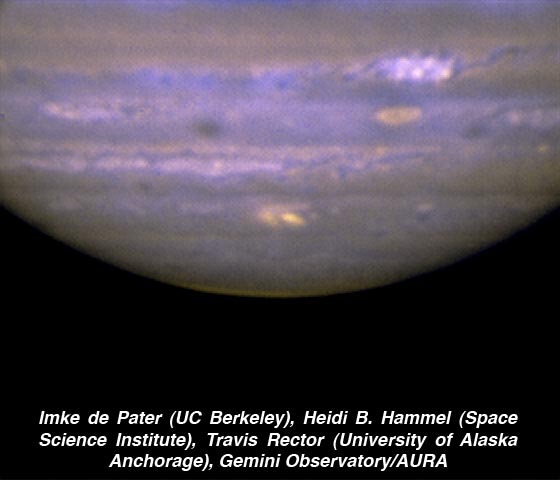
Captured by Gemini Telescope. Jupiter is sporting a glowing bruise after getting
unexpectedly whacked by a small solar system object, according to astronomers
using the Gemini North telescope on
NASA's Jet Propulsion Laboratory is introducing a new Web site that will provide a centralized resource for information on near-Earth objects – those asteroids and comets that can approach Earth. The "Asteroid Watch" site also contains links for the interested public to sign up for NASA's new asteroid widget and Twitter account. The new Asteroid Watch site is online at http://www.jpl.nasa.gov/asteroidwatch .
According to a new interim report (also here) from the National Research Council, NASA’s current near-Earth object surveys will not meet the congressionally mandated goal of discovering 90 percent of all objects over 140 meters in diameter by 2020.
New research
may have answered a piece to the puzzle - how big were the first planetesimals?
The paper, "Asteroids Were Born Big" is
available now online from the ScienceDirect website and will be available in a
future edition of the journal Icarus. It is also available here.
The Late Heavy Bombardment may have been more cometary than asteroidal. Paper here.
Jupiter targeted again. Antony Wesley’s observations.
The UCAC3 catalog will be released in 2009 August
Website updates
The Space Missions page includes details on all missions to asteroids.
– WISE, is a NASA-funded Explorer mission, to be launched in 2009 December. Among the objects WISE will study are asteroids, the coolest and dimmest stars, and the most luminous galaxies.
The Asteroid News page contains details of recent discoveries;
– companion to 2002 XH91 discovered
– 1994 CC found to be a triple asteroid
See Meetings page for details on all known
meetings)
– The
Malta Symposium on Hazardous Near Earth Asteroids will
be held at the Russian Cultural and
– This is a preliminary notice to announce that European Symposium on
Occultation Projects (ESOP) XXIX will be held in the City of York, UK, from
Friday August 20 to
Observations from members received during July and August 2009 can be accessed here.
Websites added to the Links page
– Lunar and Planetary Institute – Terrestrial Impact Craters, Second Edition
–
NASA’s JPL Asteroid Watch
–
August 2009
Paper
‘A method of determining V magnitudes of asteroids from CCD images’ by
Occult
Version 4.0.6.7 can be downloaded from http://www.lunar-occultations.com/occult4/occult406%20update.zip
Most users of Occult will not need to download this update.
However note the 'Other changes' below. Anyone predicting Asteroid Occultations
***should*** download the update. The main change in this version concerns the
probability estimates for occultations involving slow-moving asteroids. For all
occultation predictions, there is an along-track uncertainty that is indicated
as an uncertainty in the time of the event. That uncertainty necessarily
involves a corresponding uncertainty in the rotational orientation of the
Earth. Up until now, that uncertainty in the orientation of the Earth has not
been allowed for in the prediction uncertainty - mainly because the effect is
usually very small. However when the asteroid motion across the Earth is slow,
the effect can be significant. This version adjusts the 1-sigma uncertainty lines,
and the predicted uncertainty at a location, for this effect. This correction
has immediate relevance for the occultation by Philosophia in
Other changes included are:
- on the main form, access to the 7-Timer weather prediction for your 'home' site (limited to cloud and temperature). This provides ready access to a 3-day cloud forecast.
- for lunar occultations, provided some base functionality for reporting double star observations - including the ability to copy and paste a LiMovie light curve directly into an email message from the
clipboard..
Dave Herald
Details
of 2009 Planetary Society Gene Shoemaker Near Earth
Object grants to Russell Durkee of
An updated list of Damocloids can be found here.
A procedure developed by Adam Block and Ron Wodaski describing the use of Astrometrica can be accessed here.
A minor update of OccultWatcher and the IOTA Reporting Addin has been released. It can be accessed via Help/Check for updates and following the link to update. All resolved issues are minor except for a bug where version 1.0 of the IOTA Reporting Addin would fill in incorrectly the UCAC2 star number in the excel reports in some cases.
The New
Horizons team is fondly remembering Venetia Burney Phair, the “little girl” who
named Pluto, who died April 30 at her home in
The Astronomer reports; (6708) BOBBIEVAILE. D. Pray,
Carbuncle Observatory,
The
UK
Minor Planet Bulletin issue 36-3 (2009 July-September) is available as a free PDF download
Asteroid discovery statistics can be accessed here. Amateurs are still doing quite well it would seem.
From the Minor planet Mailing List
May
20, 2009
Dwayne Brown
Headquarters, Washington
202-358-1726
dwayne.c.brown@
Jim Scott
University of Colorado, Boulder
303-492-3114
jim.scott@colorado.
RELEASE: 09-111
NASA STUDY SHOWS ASTEROIDS
WASHINGTON -- A NASA-funded study indicates that an intense asteroid
bombardment nearly 4 billion years ago may not have sterilized the early Earth
as completely as previously thought. The asteroids, some the size of
microbial life on Earth could have found refuge in these habitats. If life had
not yet emerged on Earth by the time of the bombardment, these new subsurface
environments could have been the place where
terrestrial life emerged. "Even under the most extreme conditions we
imposed on our model, the bombardment could not have sterilized Earth
completely," said Abramov, lead author of the paper. "Our results are
in line with the scientific consensus that hyperthermophilic, or 'heat-loving,
For more information about NASA's astrobiology activities, visit: http://astrobiology
If you are interested in Solar System dynamics then give Solex a try.
AIP4WIN version 2.3.0 is now available.
LISA,
the joint NASA/
ESO 16/09 – Science Release. A new study published in Nature this week reveals that asteroid surfaces age and redden much faster than previously thought — in less than a million years, the blink of an eye for an asteroid. This study has finally confirmed that the solar wind is the most likely cause of very rapid space weathering in asteroids. This fundamental result will help astronomers relate the appearance of an asteroid to its actual history and identify any after effects of a catastrophic impact with another asteroid.
The STEREO spacecraft are entering the Earth’s L4 and L5 points which may hold small asteroids which could be leftovers from the collision between the Earth and a Mars sized body 4.5 billion years ago. More detail.
Peter Jenniskens led an expedition into the
For
the last two years, astronomers have suspected that a nearby white dwarf star
called GD 362 was "snacking" on a shredded asteroid. Now, an analysis
of chemical "crumbs" in the star's atmosphere conducted by NASA's
Spitzer Space Telescope has confirmed this suspicion. Read more and more
Websites of interest that have been added to the Links page;
Minor Planet Lightcurve Data collected by Frederick Pilcher, a member of The Astronomical Society of Las Cruces
Astrometry
‘how-to’ by Tim Spahr of the
Portal to the universe. Although not an
asteroid specific site it does include asteroid info and, as they say, much,
much, more!!!
April 2009
Data on the close pass of asteroids 2009 DD45, 2009 DO111 and 2009 FH added to Asteroid News page.
A
Yahoo group for Project Pluto’s Find_Orb software has been set up at http://groups.
OccultWatcher 3.2 has been released and can be downloaded from http://www.hristopavlov.net/OccultWatcher/publish.htm
Philippe Deverchère has released a new version of C2A that can now draw prepoint maps for occultation events. You'll need to download and install C2A ver 2.0.31 to be able to do that. There is also a new version of the C2A Add-in for OccultWatcher. You can download this using the update process in Occult Watcher Go 'Help' -> 'Check for Updates' and then click on the update link to update the C2A Add-in. Then Go 'Add-ins' -> 'Configure Add-ins' -> 'C2A Add-in' to configure the new settings.
A new version of Occult is available and can be downloaded from IOTA website
Asteroid 7102 has been named after Neil Bone, Director of the BAA’s Meteor Section.
The
April-June 2009 issue of The Minor Planet Bulletin can be download
from here
The presentation on 2008 TC3 has been updated with information relating to the
discovery of fragments
The
latest release of the Asteroid Lightcurve Database (LCDB) is now available on
the CALL site: http://www.minorpla
A new page, Video processing, describing how to subtract dark frames and make astrometric measurements from video has been added.
February 2009
2009 BB77 was discovered by ARPS Director
(1) Ceres least distance from Earth for 150 years.
If you want to know how Gauss
worked out the orbit of (1) Ceres then read this
Version 4.0.5.20 of Occult is now available at: http://www.lunar-occultations.com/occult4/occult405%20update.zip Just unzip the download file
into the Occult 4 directory. A full list of the changes is in the file
Updates.txt that will be in the Occult 4 directory.
Fragments
of asteroid 2008 TC3 which, exploded in the atmosphere over
To estimate the approximate shape of an asteroid from occultation data usually requires positive reports from several observers however Andreas Eberle has developed a method of doing so from a single observation. A report can be accessed here.
A
guide to asteroid discovery has been published on the website of
the Sierra
Stars Observatory Network This network
comprises two robotic telescope on which amateurs can buy time.
Eleanor
"Glo" Helin passed away in late January 2009. She was one of the
pioneers of the search for Near Earth objects (NEO’s) and established and led
the NEAT Project at JPL. The NEAT Program discovered hundreds of NEO’s, many
comets, and 64 Potentially Hazardous Asteroids (
From BAA electronic
bulletin 00380 – (7102)
Neilbone. The following citation has appeared in M.P.C. 65121: (the
asteroid was) discovered in 1936 July 12 by C. Jackson at
A
recent article in the
Magnitude
Alert Program (
A team of French and Italian astronomers have devised a new
method for measuring the size and shape of asteroids that are too small or too
far away for traditional techniques, increasing the number of asteroids that
can be measured by a factor of several hundred. This method takes advantage of
the unique capabilities of
ESO's Very Large Telescope Interferometer (VLTI). ESO
04/09 – Science Release
The MESSENGER spacecraft reached its orbital perihelion on 2009 Feb 9 and passed within 0.31 astronomical units (AU) of the Sun. The mission's imaging team is taking advantage of the probe's proximity to the Sun to continue their search for vulcanoids - small, rocky asteroids that have been postulated to circle the Sun in stable orbits inside the orbit of Mercury.
A paper ‘Long term impact risk for (101955) 1999 RQ36’ is available here
The Catalina Sky Survey
(
A new book well worth a read. ‘The
Hunt for Planet X – New Worlds and the Fate of Pluto’ by Govert Schilling,
published by Springer (£14.25). The
book is about the discovery of the Edgeworth – Kuiper belt and strongly focuses
on the human side of the story, with many personal anecdotes. Probably the
first popular-level book that gives an in-depth description of the discovery of
Eris (2003 UB313), covers the row over the discovery priority of Haumea (2003
EL61) and the 'demotion' of Pluto from planet to dwarf planet. Don’t forget to
buy your books at Amazon via the BAA Journal website
2008 December
Please note that the BAA Observers’ Workshop, Asteroids
Comets and Meteors, scheduled to take place in February 2009 has been postponed
Asteroid and Dwarf Planet data for
2009 has been added to the What to Observe page.
Observations by
the Spitzer Space Telescope have
revealed two asteroid belts around the star Epsilon Eridani
A paper describing the YORP effect
in asteroid (1620) Geographis can be found here
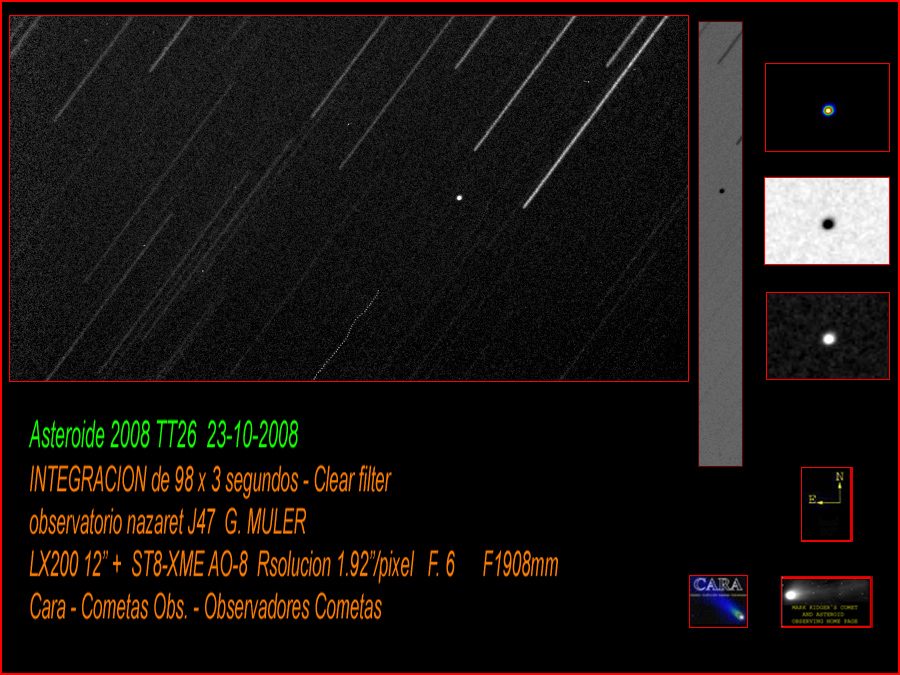
A light curve of NEO 2008 TT26 can
be found here and an image here

2008 TC3 burnt up in the
atmosphere over northern
A new, intermediate release of the Asteroid Lightcurve
Database (LCDB) maintained by
Pan-STARRS news
The new AstDys information system
is now at; http://hamilton.
A dedicated follower of asteroids rather than fashion but
possibly that as well !!.
turn out as NEOs. His very first one was 2002 LG3 on 2002
June 10/11 so it is an impressive statistic and is a monumental achievement
requiring dedication, etc. in the face of the English weather! To put it in
perspective, Siding Spring in
Issue 36-1 (2009 January-March) of the Minor Planet Bulletin
is available as a free download from
http://www.minorpla
Asteroid families can be identified by their colour – paper here
Websites added to links page;
Impact calculator – informative and simple to use
Crni Vrh Observatory – Asteroid and Comet Observations
The UK NEO Information Centre has a new website address
2008 October
On 2008 October 29
2008 SV11 – an
observing project for the New Year. See
‘What to Observe/Observing
projects/Asteroid 2008 SV11’ page for
further information
2008 TC3 burnt up in the
atmosphere over northern
Close approaches of
Potentially Hazardous Asteroids to the inner planets by Andrew Lowe. Andrew’s website has some interesting information on the use of on-line
archives to discover asteroids.
Some developments in the reporting
of absolute magnitudes can be found here
‘The Great Planet Debate: Science
as Process’ conference can be accessed here
The Association of Space Explorers
report ‘Asteroid threats: A Call for Global Response’. News and presskit
Observations recently received
from members can be found here
Websites added to Links page;
International
Occultation Timing Association (IOTA)
Occultation Section of the Royal Astronomical
Society of New Zealand
New book, Field
Guide to Meteors and Meteorites added
to Books page
BAA Observers’ Workshop No. 10,
‘Asteroids, Meteors and Comets’ added to Meetings page.
Note date may change.
2008 September
Study demonstrates how binary asteroids and asteroid moons might
have formed
Dwarf planet 2005 FY9 named
Makemake after the Polynesian creator of humanity and the god of fertility – IAU press release
IAU0806
‘Bolides and Meteorite Falls’ International conference on the occasion of the 50th anniversary of the Pribram meteorite fall to be held at the Hotel Michael, Prague, Czech Republic, 2009 May 10-15
Rosetta spacecraft - asteroid
(2867) Steins fly by
1st IAA Planetary Defense Conference,
Protecting Earth from Asteroids, to be
held in
MIT solves puzzle of meteorite-asteroid link
Astronomers find an unusual new
denizen of the Solar System – 2006 SQ372
Minor Planet Bulletin
35-4 (Oct-Dec 2008) is now available
as a free download (Zipped PDF)
International Team of Astronomers
Finds Missing Link (not early man but an asteroid, 2008 KV42, possibly
originating from the Oort Cloud !!!)
Possible existence of an outer
planet beyond the Edgeworth-Kuiper Belt and much more by Patryk Sofia
Lykawka
Two articles previously published
in the Journal of the British Astronomical Association have been added to this
website;
- ‘Asteroids: past,
present and future’. 2007 Presidential Address by
- ‘The H and G magnitude system for
asteroids’ based on 2007 February 24
BAA Observers’ Workshop at the Open University in
Two books have been added to the
‘Books’ section
‘Setting up a Small
Observatory’ by
‘Clyde Tombaugh, Discoverer
of Planet Pluto’ by David H. Levy
Two robotic telescope sites have
been added to the ‘Links’ page
- Skylive
Observations recently received
from members can be found here
2008 July
Asteroid
6137 named after
Orbit@home is a distributed computing
project to NEA search strategies and to monitor the NEA impact hazard
List
of asteroid masses is available here
Pluto and Eris are Plutoids as well as dwarf planets – read IAU Press release
IAU0804 for the full story
The Asteroid Dynamics website
has a new interface under test here
The latest Minor Planet Bulletin, 35-3: 2008 July-September,
is available as a PDF here
Is your PC clock accurate ? – read
more here
Zhongguos and Griquas – all
you need to know
Largest impact crater in the solar System ? – NASA report here
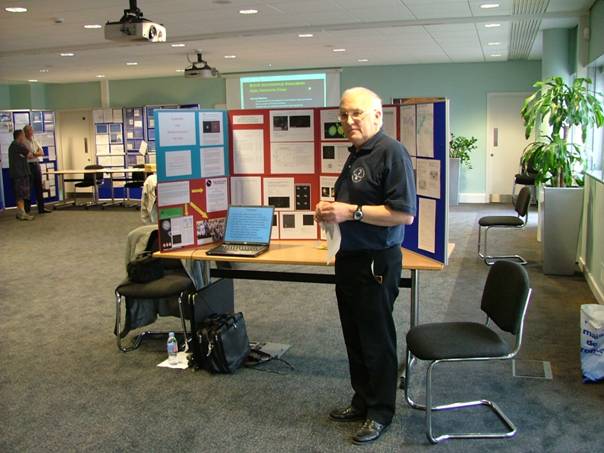
Andrew Elliot looking after the
ARPS stand at the 2008 Exhibition Meeting